About Debtclock.ca
Debtclock.ca is a Canadian Taxpayers Federation project that puts federal and provincial government debt in plain sight — live clocks so Canadians can see how quickly public debt is growing, and what that costs taxpayers in 2026.
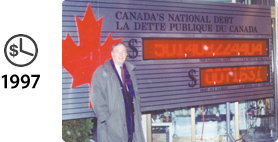
The clock was toured around the country and made headlines everywhere it went. The clock went into temporary retirement once the federal government balanced the budget in 1997 and began paying down the debt.

We pulled the old debt clock out of retirement and toured it around the country once again, warning of the size and growth of the federal debt. The 2011 tour drew national attention and renewed commitments to get debt under control.
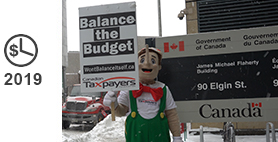
In 2015, the federal government announced they would run a $1.4 billion surplus in the 2015-16 fiscal year. During the 2015 federal election, then-Liberal leader Justin Trudeau promised if elected he would run three modest deficits and balance the budget in 2019. The federal government then ran deficits of $17.1 billion, $22.7 billion and $18.1 billion — and never balanced the budget in 2019 as promised.

Unchecked Debt
This country should know better than others the cost of unchecked debt. Because of government’s past excesses taxpayers are paying $160 million a day in interest payments on our debt.

What’s the Difference?
Every household has a budget and every Canadian family has to live within its means. The only difference between a household’s budget and that of government is the number of zeros. Families who live off their credit cards eventually end up broke because they can’t afford the monthly payments. It’s exactly the same for government.
In 1990, 38 cents of every dollar taken by Ottawa was spent just paying the annual interest on our federal debt. Thanks to increased tax revenues, lower interest rates and 11 straight years of debt repayment, that figure fell to 12 cents. Why would we want to go back?

Public Pressure
All the talk of “temporary” this and “temporary” that is bunk. Without public pressure the country will spiral into prolonged deficits, crowd out private investment, permanently increase the size of government and ultimately increase taxes to pay for it all. Over the long term, it’s a form of fiscal child abuse — making those who have no say pay for services they never used.